
Haitian Art at Auction: What Auction Prices Really Tell Us About Market Value
Auction sales have become an increasingly important reference point in the international market for Haitian art. When an important painting by a Haitian master sells for tens or even hundreds of thousands of dollars, the result attracts the attention of collectors, galleries, museums, and the international art market.
But what does a high auction price actually mean?
Does one exceptional sale automatically increase the value of every painting by that artist? Not necessarily.The relationship between auction prices and market value is much more nuanced. Auction results provide important market evidence, but they must be interpreted in the context of the individual artwork, its quality, provenance, period, subject, condition, and rarity.
Hector Hyppolite: A Landmark Example:
Material Culture’s 2025 “Mighty Haiti” Auction: A Significant Moment for Haitian Art
One of the most important recent examples of the international market for Haitian art was Material Culture’s “Mighty Haiti” auction, held in Philadelphia on October 22, 2025.
The auction brought together a substantial selection of Haitian paintings, sculpture, folk art, and cultural material. The results provide an interesting snapshot of the diversity of the Haitian art market—and, more importantly, demonstrate how dramatically the value of individual works can differ depending on the artist, quality, subject, provenance, and historical significance.
Hector Hyppolite: $355,000
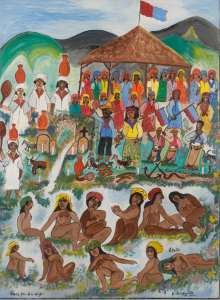
The outstanding result of the sale was Hector Hyppolite’s Purification Ceremony, circa 1948, which sold for an impressive $355,000, against an estimate of $150,000–$200,000.
The painting is particularly significant. It is a large, detailed depiction of a Vodou purification ceremony and carries an exceptional provenance. According to Material Culture, the work was purchased at the Centre d’Art in Haiti in 1948, the year of Hyppolite’s death. Its subsequent provenance includes Frances Cheston and Whitney Tower, as well as other prominent collectors. The painting had also previously appeared at a Sotheby’s Parke-Bernet auction in 1980 and was illustrated in a publication on Haitian art.
This is an excellent example of why an auction price cannot be separated from the history of the individual artwork.
The $355,000 result reflects not only the name Hector Hyppolite, but also the painting’s exceptional subject, quality, size, provenance, historical importance, and rarity.
Another Important Hyppolite Sale
In March 2024, Doyle auctioned Fête du Morts by Hector Hyppolite for $203,700, considerably above its estimate of $80,000–$120,000. Doyle described it as the artist’s second-highest auction record at that time. (Doyle)
This is an excellent example of why multiple strong results are more meaningful than a single record.
When several important works by an artist perform strongly at auction, collectors and dealers have additional evidence that demand for that artist is substantial.
More Recent Evidence: Chémen Grésié
Another useful example is Hector Hyppolite’s Chémen Grésié, which sold through Freeman’s | Hindman in April 2025 for $159,250, against an estimate of $30,000–$50,000. The reported realized price includes the buyer’s premium. (Hindman Auctions)
This is particularly interesting because the result was more than three times the high estimate.
Taken together, strong results such as these demonstrate the continuing demand for exceptional works by Hyppolite.
They also illustrate an important principle:
An artist’s market is better understood through a pattern of comparable sales than through one isolated auction record.
Philomé Obin: Another Important Haitian Market
Philomé Obin (1891–1986) provides another interesting example.
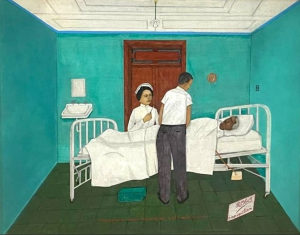
Obin is one of the foundational figures of Haitian painting, particularly known for his historical scenes, portraits, religious subjects, and depictions of life in Cap-Haïtien.
In 2023, Arrestation de Toussaint Louverture sold at Sotheby’s New York for approximately $44,450, according to current auction-market records. The subject itself is significant: Toussaint Louverture is one of the most important figures in Haitian history, and historical subjects have long played an important role in Obin’s artistic legacy. (MutualArt)
Other Obin works have produced substantially different results. Auction records show that his paintings can sell for several thousand dollars, while particularly important or desirable works can achieve considerably higher prices. (Invaluable)
This variation is extremely important for collectors.
It demonstrates that there is no single “Philomé Obin price.”
The market value of an individual Obin depends on the particular painting.
Why Can Two Paintings by the Same Artist Have Very Different Values?
Collectors sometimes make the mistake of looking at an auction record and applying that price directly to another painting by the same artist.
The art market does not work that way.
Consider two paintings by the same artist. One might be:
- an early work;
- exceptionally well preserved;
- historically important;
- from a documented collection;
- exhibited in a museum;
- a particularly important subject;
- unusually large or visually powerful.
Another painting by the same artist might be smaller, later, less representative of the artist’s career, or have weaker provenance.
Although both are authentic works by the same artist, their market values can be dramatically different.
This is why auction comparables must be selected carefully.
Auction Price Is Not the Same as Market Value
An auction result represents what a buyer—or competing group of buyers—was willing to pay for a particular work at a particular moment.
It is therefore an observable market transaction.
Market value is broader.
It takes into account the overall range of comparable transactions and the characteristics of the work being evaluated.
For example, if three exceptional paintings by an artist sell for $100,000, $125,000, and $150,000, that provides much stronger evidence of a market around that level than one painting selling for $150,000 followed by several comparable works selling for $30,000.
The distinction is especially important when discussing Haitian art because many important transactions occur outside major international auction houses.
Private sales and gallery sales m
ay never become public auction records.
The Influence of Auction Results on Collectors
Auction results nevertheless have a powerful psychological and economic effect.
A strong result can:
Increase visibility → attract new collectors → generate greater demand → encourage higher asking prices → strengthen the artist’s market.
This is particularly important for Haitian artists whose work is increasingly being discovered by international collectors.
A high-profile auction can introduce an artist to buyers who may previously have had little knowledge of Haitian art.
In this sense, auctions can help createa public price history for an artist.
But a Record Price Can Also Be Misleading
A record auction price should always be examined carefully.
Was the painting unusually important?
Was it a rare subject?
Did it have exceptional provenance?
Was it in excellent condition?
Was it included in an important exhibition?
Were several determined collectors competing for it?
Was the auction taking place during a particularly strong period for the artist?
All of these factors can influence the final price.
The record therefore tells us something very important about that particular work, but it does not necessarily establish the value of every work by the artist.
What Does This Mean for Collectors of Haitian Art?
For someone considering purchasing a Haitian painting, auction records can be extremely useful—but they should be treated as one component of research, not as the entire valuation process.
At Expressions Galerie D’Art, we believe collectors should consider the complete story of a work:
Artist + quality + period + subject + condition + provenance + rarity + exhibition history + comparable sales = a more meaningful understanding of value.
The cultural and historical importance of Haitian art also deserves consideration.
A painting is not simply a commodity. It is part of Haiti’s artistic and cultural heritage.
The Growing International Recognition of Haitian Art
The prices achieved by artists such as Hector Hyppolite and Philomé Obin demonstrate that exceptional Haitian art can command significant prices in the international auction market.
They also demonstrate something larger: the international art market is increasingly recognizing the importance of Haitian artists within the history of modern and contemporary art.
For collectors, this creates both opportunities and responsibilities.
The opportunity is to acquire important works from a historically significant artistic tradition.
The responsibility is to research carefully, understand the artist, verify authenticity and provenance, and evaluate auction results within their proper context.
Auction Records Are Part of the Story—Not the Whole Story
The most important lesson is simple:
A record auction price can influence an artist’s market, but it does not automatically establish the value of every painting by that artist.
The strongest markets are built over time through consistent demand, scholarship, museum recognition, quality exhibitions, respected galleries, collectors, and a sustained record of comparable sales.
Haitian art has a rich history that deserves to be evaluated on these terms.
Our goal is to help collectors look beyond a price tag and understand the artistic, historical, and cultural value behind each work.
Because ultimately, the true value of Haitian art is not determined by an auction room alone. The auction is one chapter in a much larger story.
Expressions Galerie D’Art — Promoting Haitian Art and Culture Since 1991.